10 Best Iconic Architecture in Montreal (Costs & Tips, 2026)
10 of the best iconic architecture in Montreal, QC — your local answer to the world's best, picked for real costs and real local tips. Save one, track your experiences, and share them with friends.
Find & track best near you →
Find your best local iconic architecture
🔍 Search “your city best iconic architecture”

Habitat 67
Montreal's own top architecture pick is also one of the world's best, full stop — this is the same Habitat 67 that ranks on Tengoo's global architecture top 10, not a hometown-favorite consolation entry. Architect Moshe Safdie built it as his master's thesis, then actually got to build it for real for Expo 67, stacking 354 identical concrete cubes into a form that still reads as futuristic decades later. Free to view from the Old Port or across the water; it's still occupied as private apartments, so there's no interior access.

Notre-Dame Basilica
The interior is deep blue and gold rather than the stone-grey most Gothic Revival churches default to, deliberately designed to evoke a starry night sky over the altar — a genuinely different visual identity from its Parisian namesake, not a copy. Fifteen Canadian dollars for basilica entry in Vieux-Montréal (Old Montreal), and the evening sound-and-light show "AURA" projected onto the interior is a separate paid add-on worth timing a visit around.

Underground City (RÉSO)
Locals just call it "RÉSO," a play on the French word for network, and it's genuinely the largest underground complex in the world by floor area — 32 kilometres of connected tunnels linking metro stations, shopping malls, offices, and apartment buildings, built up gradually since the 1960s rather than planned as one project. Free to walk, and it's a real practical necessity rather than a novelty during Montreal's genuinely harsh winters, not just a tourist curiosity.

Saint Joseph's Oratory
The largest church in Canada, its copper dome one of the largest in the world, built on the side of Mount Royal by Brother André, a doorkeeper later canonized as Saint André Bessette after a lifetime credited with thousands of reported healings. Free to enter; nearly 300 steps lead up to the main basilica, though an elevator inside handles most of the climb for anyone who'd rather skip the stairs.

Olympic Stadium & Montreal Tower
Olympic Stadium & Montreal Tower
The stadium's construction debt from the 1976 Olympics famously took Montreal taxpayers roughly 30 years to pay off, long enough that it earned the nickname "the Big Owe" among longtime residents. Twenty-eight Canadian dollars for the cable car up the Montreal Tower, the tallest inclined tower in the world at 45 degrees, with an observation deck delivering the best single skyline view in the city.

Biosphère
Buckminster Fuller's geodesic dome for the American pavilion at Expo 67 survived a 1976 fire that burned off its original acrylic skin, leaving the bare steel lattice exposed — the skeletal look visible today isn't a design choice, it's what's left after the fire, now the museum's own distinctive identity. Eighteen Canadian dollars, now an environment and sustainability museum inside the same frame.

Montreal City Hall (Hôtel de Ville)
French President Charles de Gaulle delivered his "Vive le Québec libre!" speech from the balcony here in 1967, a genuinely diplomatically explosive moment — Canada nearly expelled him over it — that's still referenced constantly in any discussion of Quebec's own sovereignty movement. Free to view the Second Empire-style exterior and public areas; guided interior tours run on a limited schedule and are worth checking ahead.

Windsor Station
Built in 1889 as the headquarters and terminal of the Canadian Pacific Railway, a genuinely fortress-like Romanesque Revival building in rough-cut grey limestone that once handled the trains carrying passengers across the entire country. Free to walk through; passenger trains no longer stop here, but the building survives connected directly into the Underground City network, repurposed rather than abandoned.
 Representative photoChrist Church Cathedral
Christ Church Cathedral
Christ Church Cathedral
The entire cathedral was engineered to "float" on a concrete raft above an underground shopping mall built beneath it in the 1980s, a genuine structural feat that let a 19th-century Gothic Revival landmark survive commercial redevelopment pressure rather than being demolished for it. Free to enter, an active Anglican cathedral rather than a static historic site, with a spire made of aluminum rather than the original stone, replaced decades ago when the stone proved too heavy for the foundation.
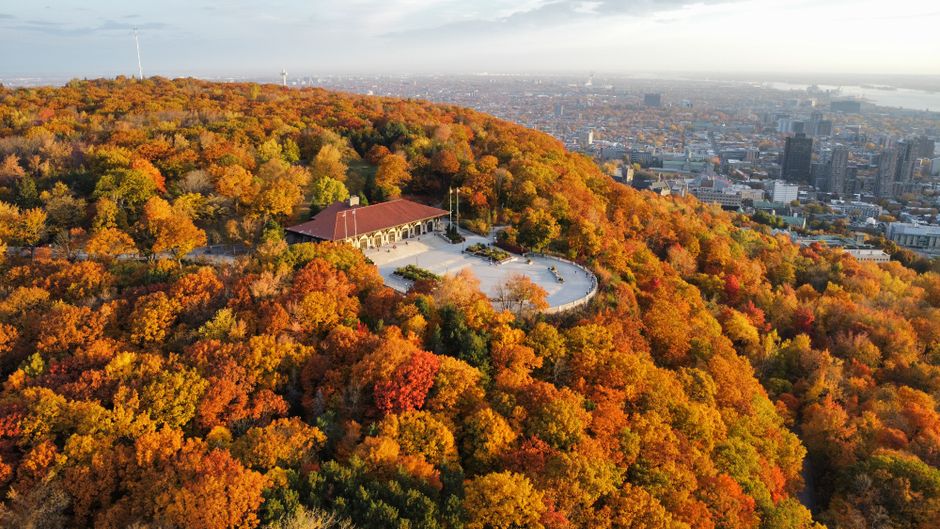
Mount Royal Chalet & Cross
The mountain the city is named for isn't much of a mountain — more a large hill — but the Kondiaronk Belvedere lookout beside the 1932 chalet delivers one of the clearest skyline views in the city, and the massive illuminated cross above it, originally lit in 1924, is visible from most of Montreal after dark. Free, and the cross switches to purple lighting on the death of a pope, a tradition most visitors never learn the reason for.
Frequently asked questions
How much does Habitat 67 cost?
Free. Montreal's own top architecture pick is also one of the world's best, full stop — this is the same Habitat 67 that ranks on Tengoo's global architecture top 10, not a hometown-favorite consolation entry. Architect Moshe Safdie built it as his master's thesis, then actually got to build it for real for Expo 67, stacking 354 identical concrete cubes into a form that still reads as futuristic decades later. Free to view from the Old Port or across the water; it's still occupied as private apartments, so there's no interior access.
How much does Notre-Dame Basilica cost?
15 CAD. The interior is deep blue and gold rather than the stone-grey most Gothic Revival churches default to, deliberately designed to evoke a starry night sky over the altar — a genuinely different visual identity from its Parisian namesake, not a copy. Fifteen Canadian dollars for basilica entry in Vieux-Montréal (Old Montreal), and the evening sound-and-light show "AURA" projected onto the interior is a separate paid add-on worth timing a visit around.
How much does Underground City (RÉSO) cost?
Free. Locals just call it "RÉSO," a play on the French word for network, and it's genuinely the largest underground complex in the world by floor area — 32 kilometres of connected tunnels linking metro stations, shopping malls, offices, and apartment buildings, built up gradually since the 1960s rather than planned as one project. Free to walk, and it's a real practical necessity rather than a novelty during Montreal's genuinely harsh winters, not just a tourist curiosity.